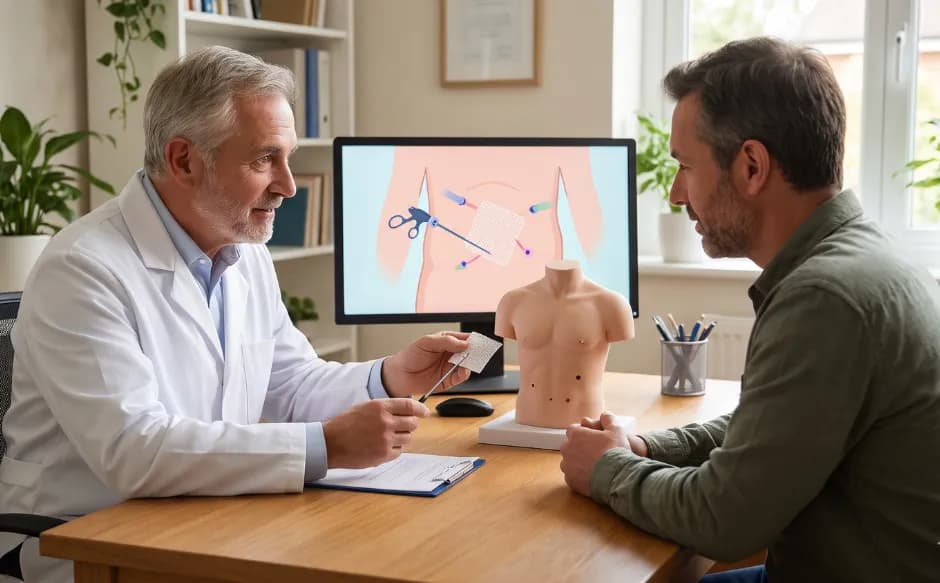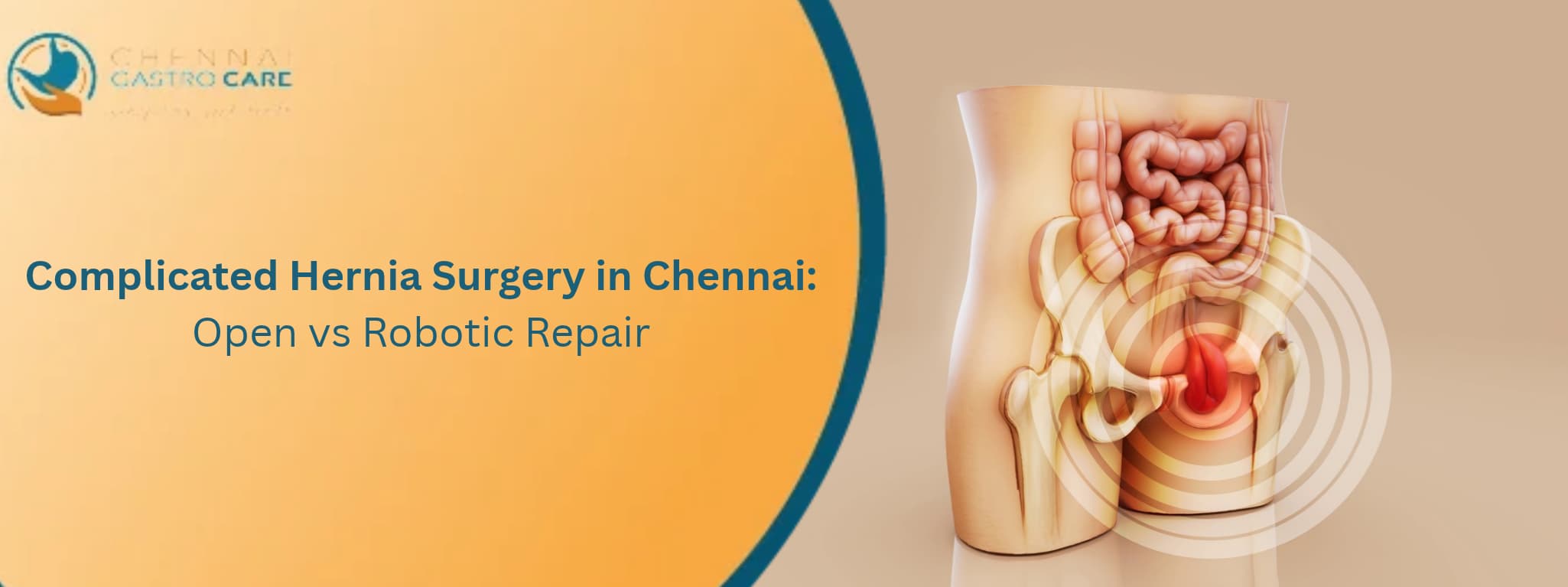

While most hernias can be resolved with standard, routine procedures, a complicated hernia, whether massive in size, returning after a previous repair, or trapped with compromised blood supply demands a far higher level of surgical expertise and customized planning. For patients in Chennai facing complex abdominal wall defects, deciding on the right surgical path often comes down to a crucial choice: time-tested open reconstruction versus precision robotic-assisted repair.
Neither approach is universally "better"; each serves distinct anatomical needs, safety priorities, and recovery goals. While robotic surgery provides magnified 3D visualization and smaller incisions, open surgery remains an indispensable lifeline for emergency strangulation and severely scarred abdomens. This guide breaks down what makes a hernia complicated, compares open and robotic repairs side-by-side, and outlines the critical clinical factors your surgical team evaluates to ensure a durable, complication-free outcome.
What Makes a Hernia "Complicated"?
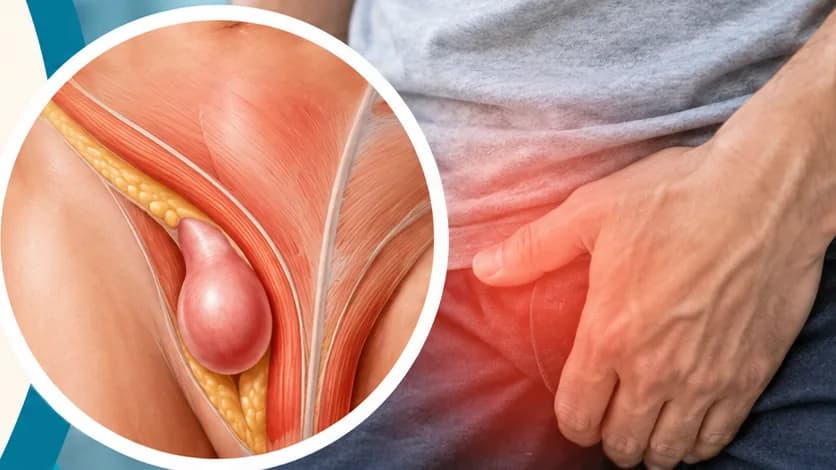
A hernia is a gap in the abdominal wall that lets fat or bowel push through. Most are routine to fix. A complicated hernia is one where the hernia itself, the timing or your general health makes repair harder.
When a Hernia Gets Stuck
An incarcerated hernia is stuck and cannot be pushed back in. It is not an emergency on its own, but it needs prompt treatment so it does not progress to strangulation. Strangulation means the blood supply to the trapped tissue is cut off, and that is a surgical emergency.
Go to a hospital immediately if you have sudden severe pain, vomiting, fever, or a firm, tender lump that won't go back in, or if the bulge turns red, purple or dark.
Recurrent hernias
When a hernia returns after an earlier repair, the surgeon works through scar tissue and sometimes old mesh. The anatomy is less forgiving, so the plan needs more care.
Large incisional and ventral hernias
Incisional hernias form at the site of a previous operation. When the defect is wide, the surgeon may need to release layers of the abdominal wall to bring the edges together and place a large mesh. This is called abdominal wall reconstruction, and it is the territory where the open vs robotic debate matters most.
Patient factors
Obesity, diabetes, smoking, heart or lung conditions and multiple previous surgeries all raise the risk of wound problems and recurrence. In complex repair programmes, stopping smoking before surgery is a standard requirement.
Open Repair for Complicated Hernias
Open surgical repair remains the established foundation for managing high-risk, structurally massive, or emergency abdominal wall hernias. By granting direct tactile control and unobstructed exposure, it enables surgeons to safely inspect compromised tissue, release complex muscle planes, and secure durable mesh reinforcement where minimally invasive instruments cannot safely navigate.
How it works
The surgeon makes an incision over the hernia, works under direct vision, repairs the defect and reinforces it with mesh. In large defects, techniques such as the Rives-Stoppa retrorectus repair, sometimes combined with a transversus abdominis release (TAR), place the mesh in a strong layer behind the muscle.
Where open surgery is strongest
-
Emergencies: strangulated or obstructed hernias where bowel may need to be checked or removed.
-
Very large or "hostile" abdomens: heavy scarring, infection risk or loss of abdominal domain.
-
Anaesthesia flexibility: open groin repair can be done under local or regional anaesthesia, which helps people who should avoid a general anaesthetic.
The trade-offs
The incision is larger, so pain, wound infection and fluid collection (seroma) are more likely, and the hospital stay is often longer. Done well, though, open repair gives excellent, durable results.
Robotic Repair for Complicated Hernias
How it works
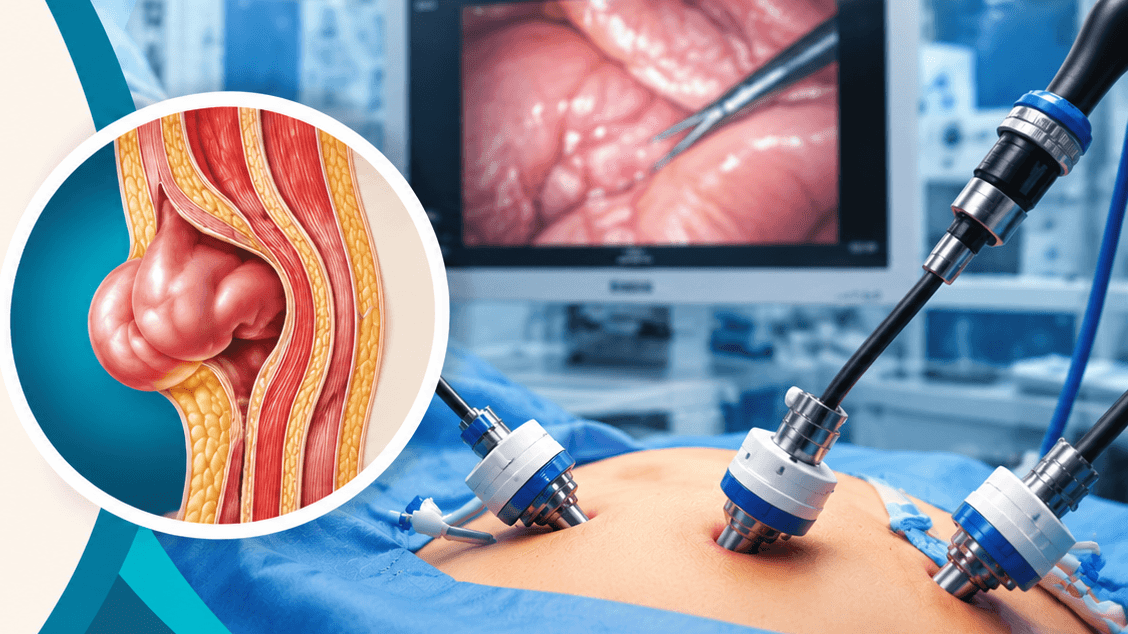
Through a few small ports, the surgeon operates from a console. The instruments bend like a wrist and the view is magnified and three-dimensional. The robot does not act on its own; it is an extension of the surgeon's hands. That precision helps the surgeon close the defect and lay a large mesh behind the muscle without a long incision.
One reason robotics appeals for complex ventral hernias is that, unlike standard keyhole repair, both open and robotic approaches allow the surgeon to close the gap in the abdominal wall.
Potential benefits
In one single-centre comparison of complex ventral hernias, robotic repair took longer but was linked to less blood loss and shorter hospital stays. Smaller incisions can also mean less wound trouble and a quicker return to routine.
Limitations
-
Longer operating time and higher cost: both are the main arguments against it, and the learning curve for the robot is steep.
-
Not suited to emergencies or abdomens that are badly scarred or infected.
-
Limited availability: only some hospitals and surgeons offer it.


Open vs Robotic Hernia Repair: Side-by-Side
| Factor | Open repair | Robotic repair |
|---|---|---|
| Incision | One larger incision | A few small ports |
| Best for | Emergencies, very large or infected fields | Selected complex ventral and recurrent hernias |
| Operating time | Usually shorter | Usually longer |
| Pain and wound issues | More likely | Often less |
| Hospital stay | Often longer | Often shorter |
| Cost | Lower | Higher |
| Anaesthesia | Can sometimes use local/regional | General anaesthesia |
What the evidence actually says
For common groin hernias, randomised trials show no meaningful difference between robotic and laparoscopic repair in complications, pain or recovery, only longer operating times with the robot. For complex abdominal wall hernias the results look promising, but much of the data comes from small, single-centre studies. That is why the decision should be made case by case.
Which Approach Is Right for You?
Choosing between open and robotic repair is never a one-size-fits-all decision; it depends entirely on the urgency of your symptoms, previous surgical history, and overall physical health. Your surgical team balances the immediate safety of trapped tissue against long-term abdominal wall stability to determine which approach minimizes complication risks and delivers the most durable repair.
Questions your surgeon will weigh
- Is the hernia stuck, painful or showing signs of strangulation?
- How large is the defect, and is it a first repair or a recurrence?
- Have you had previous abdominal surgeries or mesh repairs?
- Are you fit for general anaesthesia? Do you have diabetes, a high BMI or a smoking history?
- What is the surgeon's own experience with this exact type of repair?
If it is an emergency
Open surgery is usually the safest route because speed and direct access matter most. Do not delay comparison shopping.
If it is planned
You have time to optimize. Controlling blood sugar, stopping smoking and improving fitness before surgery can noticeably improve healing and lower recurrence risk.
Recovery: What to Expect
Recovery depends on the hernia and the approach. After a complex repair, expect a few days in hospital, gradual walking from day one, and a period of avoiding heavy lifting that your surgeon will set, often several weeks. Following the advice on diet, fluids and activity helps protect the repair. Contact your surgeon promptly if you notice fever, redness, worsening pain or a new bulge.
Why Patients in Chennai Trust Chennai Gastro Care
Complicated hernias reward experience. Dr. Deepak Subramanian, Senior Consultant in Laparoscopic, GI and Bariatric Surgery (MBBS, MS, MRCS Edinburgh, FIAGES, FALS), has more than 14 years of experience and over 5,000 surgeries, with a focus on hernia repair and advanced minimally invasive surgery.
At Chennai Gastro Care in Alwarpet, every case is assessed by the surgeon himself. You get a clear explanation of your diagnosis, honest options in plain language, and a recovery plan with follow-up.
**Not sure whether your hernia is "complicated"? Chat with our care assistant for quick guidance and support