
If you've been told you need hernia surgery, one of the first questions you'll face is whether it should be done laparoscopically or through open surgery. Both approaches repair the hernia and both are widely used in Chennai, but the right choice depends on the type of hernia, its size, your medical history, and whether it's your first repair or a recurrence. If you're still working out which type of hernia you have, our Hernia Types & Procedures guide is a good starting point before deciding on an approach.
At Chennai Gastro Care, Dr. Deepak Subramanian evaluates each of these factors before recommending an approach, rather than defaulting to one technique for every patient.
What's the Difference Between the Two?
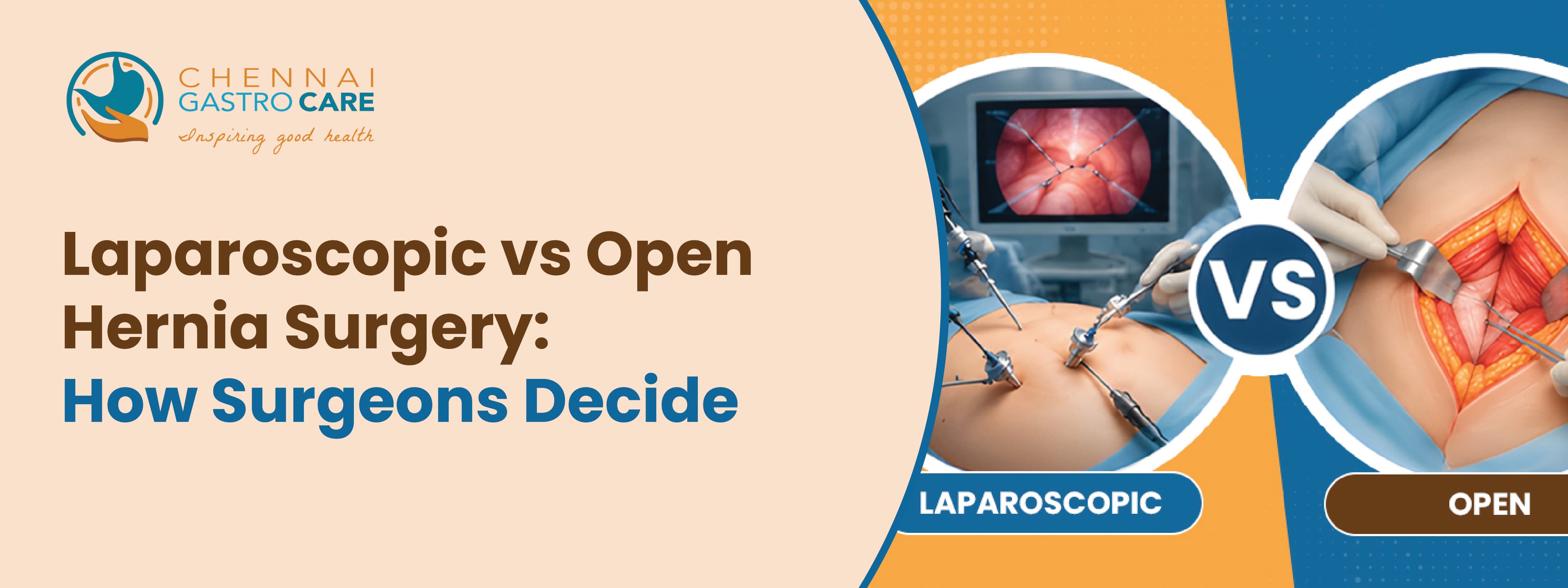
Open hernia surgery involves a single larger incision at the hernia site. The surgeon directly accesses the weakened area, repairs it, and in most cases reinforces it with a synthetic mesh. It's a well-established technique with decades of outcome data behind it, and it remains the standard for certain complex cases.
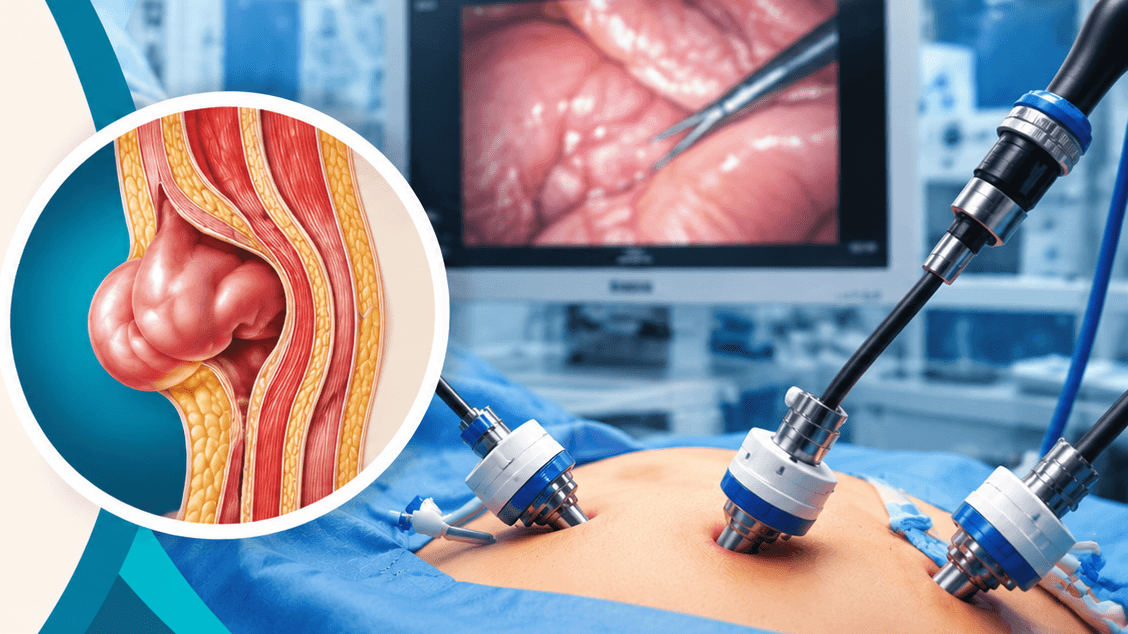
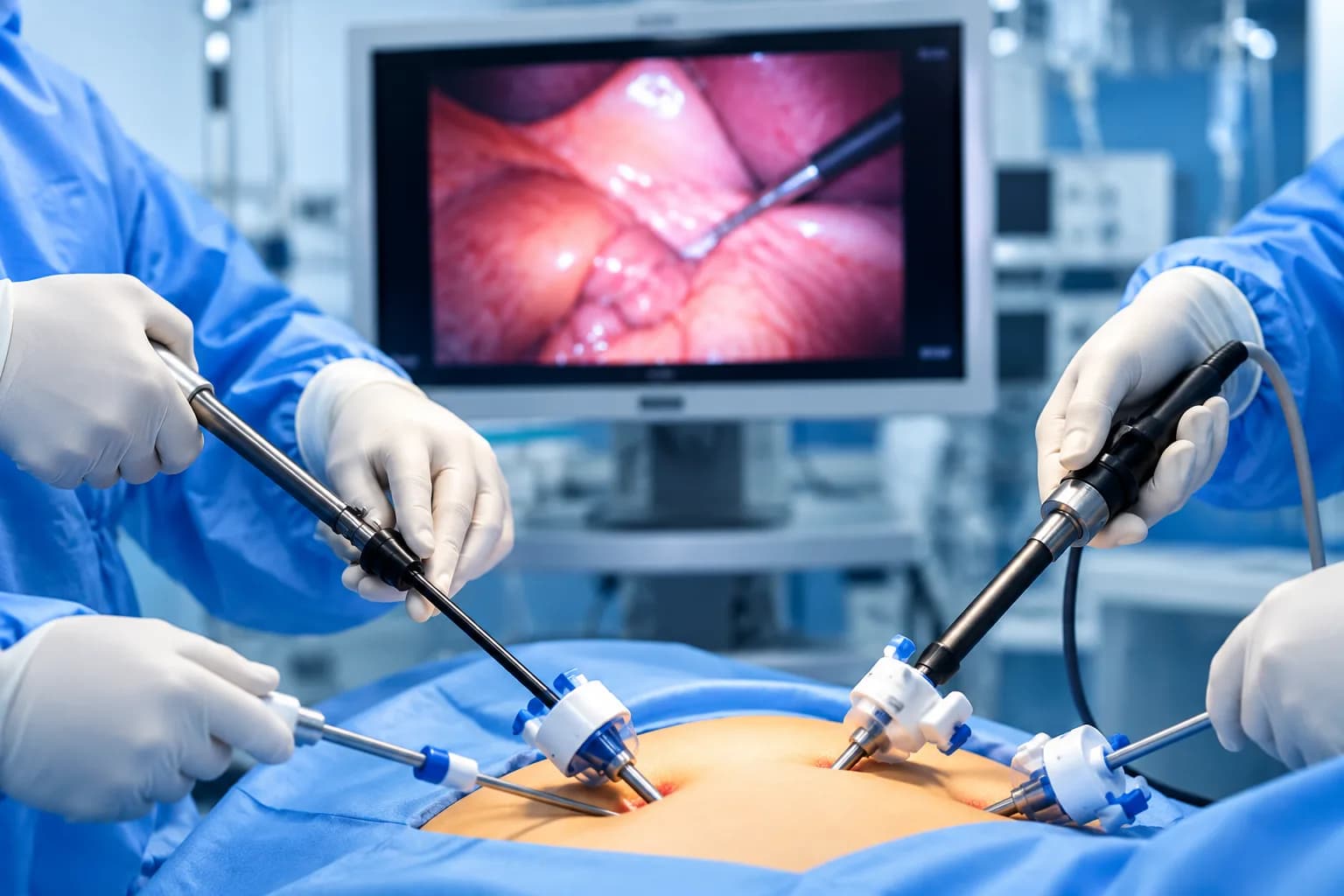
Laparoscopic hernia surgery uses 3-4 small incisions instead of one large one. A camera (laparoscope) and specialized instruments are inserted through these incisions, and the repair is done with the surgeon viewing the internal anatomy on a screen. Mesh placement is typically done from behind the abdominal wall rather than through it, which can reduce trauma to the surrounding tissue.
Neither approach is universally "better." The right one depends on the patient in front of the surgeon, and a good surgeon will be able to explain clearly why one is being recommended over the other for your specific case.
How Surgeons Actually Decide
There is no one-size-fits-all approach to hernia surgery. Surgeons look at several details about the hernia, your symptoms, and your overall health before deciding which treatment approach is appropriate
1. Type and Location of the Hernia
Inguinal hernias and ventral hernias are generally strong candidates for a laparoscopic approach, particularly when bilateral (both sides) or recurrent. Very large hernias, or those with complications like strangulation, often need an open approach for direct control and immediate access to at-risk tissue.
2. First-Time vs Recurrent Hernia
For a recurrent hernia, especially one that was originally repaired via open surgery, a laparoscopic approach can access the area from a different plane, avoiding scar tissue from the first surgery. This often makes laparoscopic repair the preferred option for recurrences, since operating through old scar tissue with an open approach can be more difficult and carries a higher risk of complications.
3. Patient's Overall Health
Laparoscopic surgery requires general anesthesia and insufflation (filling the abdomen with gas to create working space), which raises cardiac and respiratory workload during the procedure. This makes it less suitable for patients with specific conditions such as severe COPD, uncontrolled heart failure, a recent heart attack, or significant pulmonary hypertension. Patients on blood thinners, with uncontrolled bleeding disorders, or with extensive scar tissue from multiple prior abdominal surgeries may also face higher risk with the laparoscopic approach. In these cases, open surgery under local or regional anesthesia may be safer, even if recovery is somewhat longer.
4. Hernia Size and Complexity
Hernia defects are generally grouped as small (under 4cm), medium (4 to 10cm), or large (over 10cm). Large defects, hernias involving significant loss of abdominal domain, or those requiring extensive fascial reconstruction are frequently better managed with an open approach, sometimes combined with component separation techniques such as anterior component separation or posterior transversus abdominis release (TAR), which create additional working space to close the abdominal wall without excessive tension. Laparoscopic repair becomes technically difficult once a defect grows beyond this range, since achieving adequate mesh overlap and a tension-free closure through small ports gets harder as the defect size increases.
5. Recovery Priorities
Patients balancing surgery with work or caregiving responsibilities often prioritize faster return to activity, which laparoscopic surgery generally supports better due to smaller incisions and less post-operative pain. This is a reasonable factor to raise with your surgeon, though it shouldn't override medical suitability.


A Typical Decision in Practice
Consider two patients with the same diagnosis: an inguinal hernia. The first is a 35-year-old office worker with no prior surgeries and a healthy weight a strong candidate for laparoscopic repair, likely as day-care surgery with a return to desk work within two weeks.
The second is a 68 year-old with a large recurrent hernia after a prior open repair, plus a cardiac history that makes prolonged general anesthesia riskier. For the second patient, a carefully planned open repair, possibly under regional anesthesia, may be the safer route despite the longer recovery. This is why the same diagnosis doesn't always lead to the same surgical plan.
Comparing Laparoscopic vs Open Hernia Surgery
Once you understand the key decision factors, it helps to see how the two approaches actually compare on the details that matter most to patients, incision size, hospital stay, recovery time, and the types of hernias each is best suited for.
| Factor | Laparoscopic | Open |
|---|---|---|
| Incision size | 3-4 small (5-10mm) | 1 larger (5-10cm) |
| Hospital stay | Often day-care or 1 night | 1-3 nights typically |
| Return to normal activity | Faster (1-2 weeks) | Slower (3-4 weeks) |
| Scarring | Minimal | More visible |
| Best suited for | First-time, bilateral, recurrent hernias | Large, complex, or complicated hernias |
| Anesthesia | General (usually) | Local, regional, or general |
What to Ask Your Surgeon
Before agreeing to either approach, it's worth asking:
- Why is this approach being recommended for my specific case?
- What would change if we chose the other approach?
- What's your experience with this technique for my type of hernia?
- What does recovery realistically look like for me, given my health and work situation?
- Is mesh being used, and if so, what type?
A surgeon who welcomes these questions and answers them clearly is a good sign you're getting an individualized recommendation rather than a default protocol.
What This Looks Like at Chennai Gastro Care
At Chennai Gastro Care, Dr. Deepak Subramanian (MRCS, FIAGES, FALS) brings over 14 years of experience and more than 3,000 laparoscopic and endoscopic procedures to every hernia consultation. Rather than defaulting to one technique, he assesses each patient through a detailed clinical examination and imaging where needed, then walks through both surgical options honestly, including why one may be safer or more effective than the other for that specific case.
What sets this evaluation apart:
- Individualized assessment: your hernia type, size, health history, and recovery priorities all factor into the recommendation, not a one-size-fits-all protocol.
- Advanced laparoscopic expertise: for patients who are good candidates, minimally invasive repair is available with day-care or short-stay recovery.
- Complex and recurrent case experience: for larger or recurrent hernias that need an open approach, the same surgical team manages the case end-to-end, with no handoffs between specialists.
- Transparent guidance: you'll get a clear explanation of the recommended approach, expected recovery, and cost, with WhatsApp support for quick follow-up questions before and after your consultation. If you've been diagnosed with a hernia and aren't sure which surgical approach is right for you, book a consultation with Dr. Deepak Subramanian to discuss your specific case and get a personalized recommendation, or learn more about our hernia surgery services.